A
accountable: To explain and be responsible for one’s actions. In the Parliament of Tasmania, Ministers answer to the Legislative Council and House of Assembly for their actions.
Act: A law made by Parliament, also called a statute. An Act starts as a bill and becomes an Act once it has passed both Houses of Parliament and received Royal Assent.
adjourn: To postpone, suspend or defer. In the Parliament of Tasmania, debate on a bill or other matter may be adjourned to a future time or day.
Adjournment debate: A debate at the end of each sitting day, when Members from the Legislative Council or House of Assembly make a short speech on a topic of their choice.
amendment: A change to the wording of an Act of Parliament, bill or motion.
Aye: (pronounced like “I”) The word used in Parliament to indicate a ‘yes’ or affirmative vote.
B
backbencher: A Member of Parliament who is not a Presiding Officer, Minister or Shadow Minister.
Bar of the House: The Bar of the House is the boundary of the Chamber. Only Members and Chamber staff may cross the Bar when the House is in session.
bicameral Parliament: A Parliament that consists of two Houses or Chambers. The Parliament of Tasmania is a bicameral Parliament with two Houses: the Legislative Council and the House of Assembly.
bill: A proposal for a new law or a change to an existing one.
Black Rod: The symbol of the authority of the Legislative Council and its Presiding Officer, the President.
C
Cabinet: The Premier of Tasmania and Ministers who make the key decisions regarding the administration of the State of Tasmania.
call, the: The call is the right to speak in the Chamber and is allocated by the Presiding Officer. Members seek the call by standing up and calling to the Presiding Officer.
casting vote: The deciding vote when the number of votes for and against a proposal are equal. In the House of Assembly the Speaker, or the Member in the Chair, may be required to cast their vote if the result of a Division is tied.
Chair of Committees: A Member of the Legislative Council or House of Assembly who presides over debate during the Committee of the whole House.
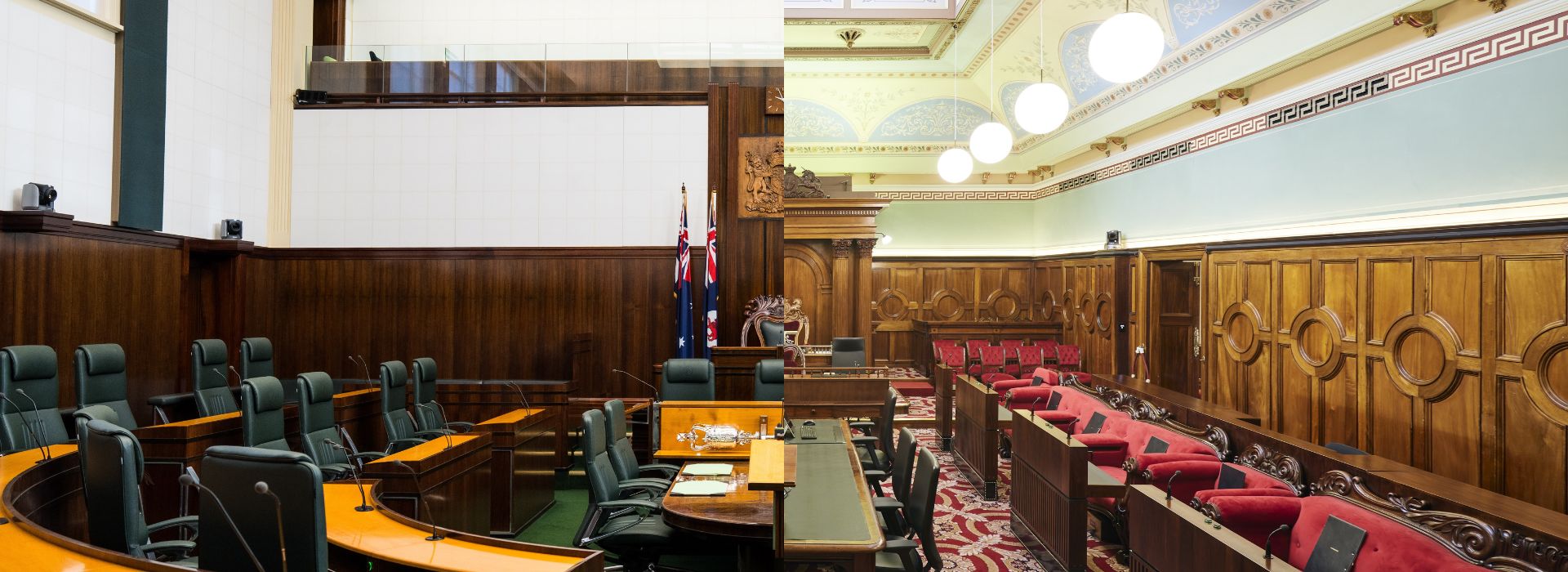
Chamber: The main meeting room of a House of Parliament. The Parliament of Tasmania has two Chambers.
Clerk of the Council: The most senior Parliamentary Officer in the Legislative Council. As an expert on parliamentary procedure, they advise the President and Members on the procedures and rules of the Council.
Clerk of the House: The most senior Parliamentary Officer in the House of Assembly. As an expert on parliamentary procedure, they advise the Speaker and Members on the procedures and rules of the House.
Committee: A small group of Members of Parliament who closely examine and then report on a matter to the wider Parliament. A Parliamentary Committee may form in the Legislative Council, the House of Assembly or be drawn from both Houses as a Joint Committee.
Committee of the whole House: A stage in the passage of legislation through the Parliament of Tasmania in which Members carefully consider a bill clause by clause and may propose amendments.
Constituency Question: An inquiry made by a Member to a Minister on behalf of someone from their electorate. The Minister must reply in writing within 30 days.
constituent: Someone who votes or lives in an area represented by a Member of Parliament.
conscience vote: Also known as a “Free Vote”. A vote in which Members of Parliament are free to vote according to their own judgement or beliefs, not necessarily according to their political party’s policies. This rarely occurs and is usually given where the issue to be voted on is an ethical issue.
cross the floor: The rare action of a Member of a parliamentary party voting against their own party in a Division.
crossbench: The Members of the Legislative Council or House of Assembly who are not Members of the Government or the Opposition.
D
debate: A formal discussion on a Bill or other matter in which different views are expressed.
deliberative vote: A deliberative vote is the normal vote of a Member of Parliament. The Speaker of the House of Assembly and the President of the Legislative Council do not cast a deliberative vote but have the casting vote in the result of a tie.
dissent: When a Member disagrees with a ruling by the Presiding Officer (President of the Legislative Council or Speaker of the House of Assembly). The issue is then debated and voted upon.
dissolution: The termination by the Governor of the House of Assembly for a general election.
Division:
1. Division: A formal vote in the Parliament of Tasmania. Members move to either side of their Chamber to show their support for or against a matter. The Members on each side are counted and their names recorded.
2. Electoral Division: A geographical area represented by Members of Parliament. Sometimes referred to as a ‘seat’ or an ‘electorate’. There are 15 Electoral Divisions in the Legislative Council and 5 Electoral Divisions in the House of Assembly.
Dorothy Dix question: A pre-planned question, usually asked by a Government backbencher of a Minister, enabling the Minister to give a prepared reply.
E
electorate: A geographical area represented by Members of Parliament. Sometimes referred to as a ‘seat’ or a ‘division’. There are 15 electorates in the Legislative Council and 5 electorates in the House of Assembly.
Electorate Office: An office within their electorate where Members work when the Parliament of Tasmania is not sitting.
Executive Government: The arm of government that decides government policy, puts these policies into practice, manages the work of Tasmanian Government departments, and introduces most bills into Parliament. In Tasmania, the Executive consists of the Premier of Tasmania and Ministers.
F
frontbencher: A Member of the Parliament of Tasmania who is a Minister or a Shadow Minister.
G
Government: In the Parliament of Tasmania, Government refers to the political party or parties with the majority support of the House of Assembly.
Governor of Tasmania: The Monarch’s representative and the formal Head of State in Tasmania. The Governor is one of the three parts of the Parliament of Tasmania.
H
Hansard: The official transcript (written record) of debates and proceedings, including committees, in the Parliament of Tasmania.
House of Assembly: One of the two Houses of the Parliament of Tasmania. Also known as the ‘lower House’.
hung parliament: A parliament in which no single political party has majority support in the House of Assembly.
I
independent member: A Member of the Parliament of Tasmania who does not belong to a political party.
interjection: An audible comment or remark from a Member of Parliament that interrupts the speech of another Member.
J
Joint Committee: A Parliamentary Committee made up of Members from both the Legislative Council and the House of Assembly.
judiciary: The arm of government with the power to interpret, apply and resolve disputes about the law. In Tasmania this is the Supreme Court of Tasmania and the Magistrates Court of Tasmania.
L
law: A rule or set of rules that apply to all people at all times, with legal consequences if they are not followed. The Parliament of Tasmania makes and updates Tasmanian laws.
Leader of Opposition Business in the House: A Shadow Minister who arranges and manages Opposition Business in the House of Assembly.
Leader of the Opposition: The leader of the political party with the second largest number of Members in the House of Assembly.
Leader of the House: The Minister who arranges and manages Government Business in the House of Assembly.
leave: When a Member seeks permission of all Members in the Chamber to do something which otherwise may not be permitted at that stage of proceedings.
legislation: A law or laws passed by Parliament.
Legislative Council: One of the two Houses of the Parliament of Tasmania. Also known as the ‘upper House’ or House of review.
legislature: The arm of government with the power to make, amend and repeal laws for a state or country. In Tasmania this is the Parliament of Tasmania.
M
Mace: The symbol of the authority of the House of Assembly and its Presiding Officer, the Speaker.
Matter of Public Importance (MPI): A short debate in the House of Assembly on a noteworthy matter.
Media Gallery: An area in the Chamber where members of the media may sit and watch proceedings.
Member of Parliament (MP): A person elected to Parliament. In Tasmania, Members of the House of Assembly are often referred to as MPs and Members of the Legislative Council are referred to as MLCs.
Minister (of the Crown): A Member of Parliament, selected by the Premier, who has been given the responsibility of managing specific areas of government policy and departments (portfolios). Together the Premier and the Ministers are known as Cabinet.
minor party: A parliamentary party with at least one member of Parliament elected to either House, but which does not have enough Members in the House of Assembly to be in Government or Opposition.
monarch: A head of state, such as a king or queen, who has inherited their position.
motion: A proposal put to the Legislative Council or House of Assembly for debate and/or decision.
N
notice: The formal process by which the Parliament is notified of forthcoming business. Motions and questions may be placed on notice to give Members or Ministers an opportunity to prepare for them. These then appear on the Notice Paper.
O
Opposition: The political party in the House of Assembly with the second largest number of Members. Sometimes known as ‘the alternative Government’.
Order of Business: The Order of Business is the document outlining the proposed work in the Chamber for the day. The Clerk of each House publishes the order of business each sitting day. It is sometimes called “The Blue”.
P
pair: By mutual agreement, to balance the legitimate absence of a Member, another Member is 'paired' and does not vote or take part in divisions.
parliament: A group of people with the authority to make laws for a country or state. The Parliament of Tasmania consists of the Governor of Tasmania, the Legislative Council and the House of Assembly.
Parliament House: The building in Hobart where the two Houses of the Parliament of Tasmania meet.
parliamentary officer: A non-elected person whose duties are to support the workings of the Parliament of Tasmania.
parliamentary privilege: The legal protection given to Members of Parliament or witnesses appearing before parliamentary committees, to make sure they cannot be sued or prosecuted for anything they say or do during parliamentary proceedings.
petition: A written request from an individual or a group of citizens to the Members of the Parliament of Tasmania to take action on a matter. It may be presented on paper or in electronic form.
point of order: An appeal by a Member to the Presiding Officer (e.g. President or Speaker) to make a ruling about whether a Standing Order has been breached.
political party: An organisation that represents a particular group of people with shared values and ideas. They aim to have members of their organisation elected to the three levels of government in Australia, including the Parliament of Tasmania.
portfolio: Areas of responsibility of a Minister, including the oversight of particular Tasmanian Government departments and agencies.
Premier of Tasmania: An elected Member of the House of Assembly who is the leader of the political party in Government, and the most senior Minister in the Tasmanian Government.
President of the Legislative Council: A Member of the Legislative Council elected by the other Members of the Council to chair the meetings and ensure the Standing Orders (rules) of the Council are followed. They are also known as a Presiding Officer.
Presiding Officer: A Member of the Legislative Council or House of Assembly elected to run the meetings of that House.
private member: A Member of the Parliament of Tasmania who is not a Minister.
prorogue: The termination of the session of Parliament by the Governor, but not a dissolution for an election. It brings an end to the business of that session and stops some committee activity; any unfinished business may be reinstated to the Notice Paper when Parliament resumes.
Public Gallery: A area in the Chamber where members of the public can sit and watch proceedings.
Q
Questions on Notice: A written request from a Member to a Minister seeking information about a portfolio area. The Minister will provide a written response at a later date.
Question Time: Time allocated during a sitting day in the Legislative Council and the House of Assembly for Members to scrutinise (question) Ministers about government policies, decisions, actions and spending.
R
reading: The formal action to mark the completion of each stage of the passage of a bill through Parliament.
resolution: Either House of the Parliament can express its opinion on any matter by resolution. A motion passed by the House becomes a resolution.
Royal Assent: The agreement to, or signing of, a bill by the Governor of Tasmania. This is the final step in the passage of legislation through the Parliament of Tasmania, and on receiving Royal Assent, the bill becomes a law.
S
scrutinise: To examine something closely. In the Parliament of Tasmania, non-Government Members closely examine the policies, decisions, actions and spending of the Government.
separation of powers: The principle that the power to govern is shared across the three arms of government; the Legislature (Parliament); the Executive (Government); and the Judiciary (Courts). This avoids one group holding all the power and protects against misuse.
Sergeant-at-Arms: A Parliamentary Officer who assists the Speaker to maintain order in the House of Assembly and to manage the wider Parliament of Tasmania.
Sessional Orders: Temporary rules used to manage the work of either House of Parliament.
Shadow Cabinet: The Leader of the Opposition and Shadow Ministers.
Shadow Minister: A Member of the Opposition allocated specific areas of government work (portfolios) to scrutinise or closely check. Together the Shadow Ministers are known as Shadow Cabinet.
sitting: A meeting of a House of Parliament or a Parliamentary Committee.
Speaker of the House: A Member of the House of Assembly elected by the other Members of the House to chair the meetings and ensure the Standing Orders (rules) of the House are followed. They are also known as a Presiding Officer.
Special Interest Matter (SIM): A short contribution by a Member of the Legislative Council on a topic of interest.
spokesperson: A Member of a minor party who is allocated a specific area of government work (portfolios) to scrutinise or closely check.
Standing Orders: The written rules and procedures that must be followed within the Legislative Council or House of Assembly.
statute: A law made by Parliament, also called an Act.
T
table:
1. To table: To formally present a document or other item to the Legislative Council or House of Assembly, for inclusion in the Parliamentary records.
2. The Table of the House: The table in front of the Presiding Officer’s Chair in either House where the Clerks sit.
U
Usher of the Black Rod: A Parliamentary Officer who assists the President to maintain order in the Legislative Council and to manage the wider Parliament of Tasmania.
V
vote on the voices: A method of voting used in Parliament. Members indicate their support for or against a question put by the Presiding Officer by calling out ‘aye’ or ‘no’.
W
Westminster system: The system of government originating in Britain, in which the Government is drawn from and directly answerable to the Parliament.
Whip: A Member of the House of Assembly selected by their political party to manage or organise their party Members within the House.
writ: The written commands from the Governor which are issued for an election and returned to commence the new Parliament and must be tabled by the Clerk.